I've had this conversation about fifty times in the last year.
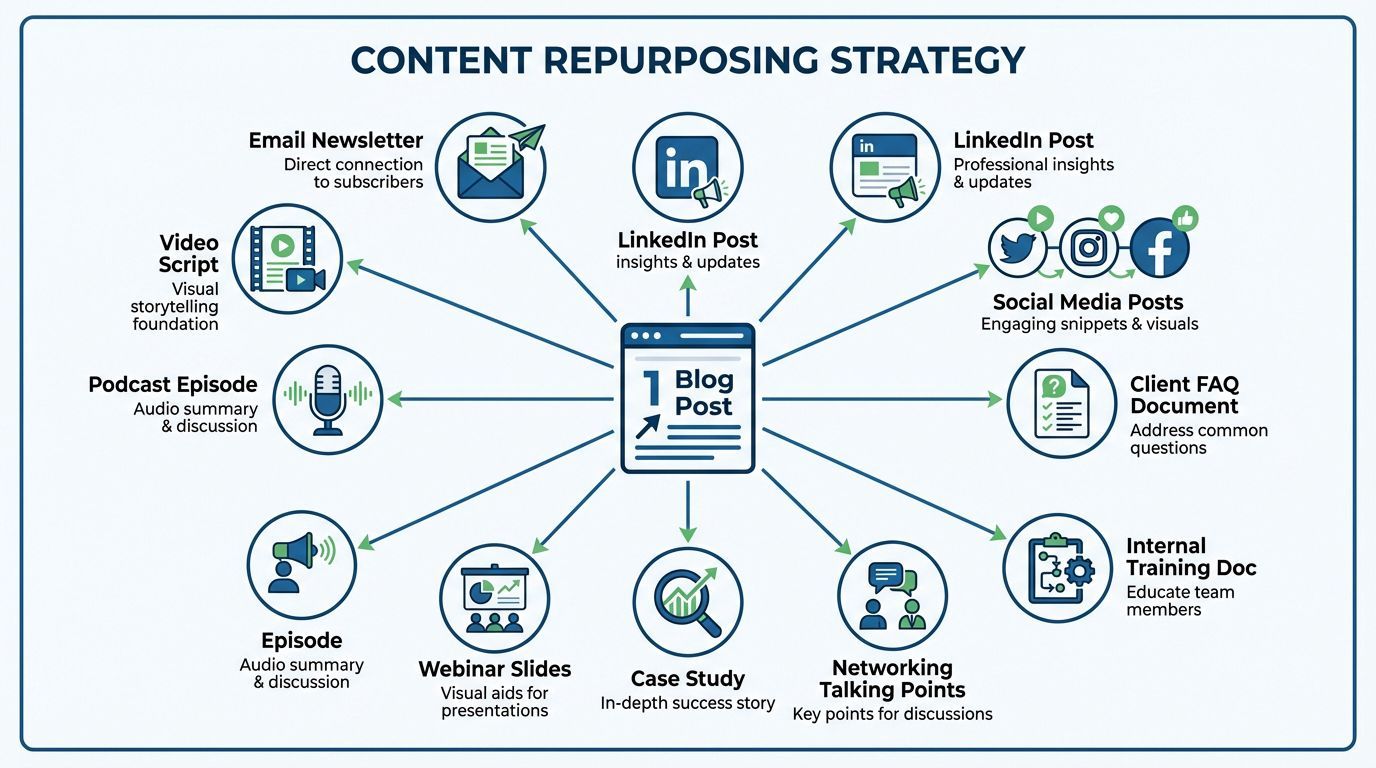
Business owner creates brilliant content. Blog post about something they actually know. Costs them four hours and genuine thinking. I suggest turning it into six other pieces - emails, social posts, client materials.
They pause. Then: "Isn't that just... recycling? Feels a bit lazy."
And there it is. The thing that stops most experts from doing the one content strategy that actually works.
Not lack of time. Not technical confusion.
The feeling that repurposing content is somehow less legitimate than creating "new" content every single time.
Why It Feels Wrong When You're The Expert
Here's what happens when you're genuinely good at something.
You write about a problem you've solved a hundred times. Contract risks, planning permission issues, cash flow patterns - whatever your expertise actually is. You explain it once in a blog post. Clear, useful, drawn from real experience.
Then someone suggests you mention it again in an email. Or bring it up on LinkedIn. Or reference it at a networking event.
And internally, you resist.
Because you're already bored of that insight. You figured it out two years ago. You've explained it to dozens of clients. The novelty wore off for you somewhere around client number twelve.
So, repurposing it feels like serving reheated food. Like you're phoning it in.
What you're missing - what every expert misses at this exact point - is that you're bored of your insight before your audience has heard it even once.
Your expertise is background noise to you. It's hard-won revelation to them.
The Expertise Paradox Nobody Warns You About
The better you get at something, the more obvious it becomes to you. And the more obvious it feels to you, the less valuable you assume it is to everyone else.
I see this most clearly with business owners who've been in their field fifteen, twenty years. They'll dismiss their best insights with "Oh, everyone knows that" or "That's just common sense."
Except it isn't. It's common sense to someone who's done it five hundred times. It's genuinely useful to someone encountering the problem for the first time.
The solicitor who's seen the same contract mistake wreck deals repeatedly - that pattern recognition is invisible to them because it's automatic. Clients would pay significant money to avoid that mistake, but the solicitor hesitates to write about it again because "I've already covered that."
You've covered it. They haven't absorbed it yet.
Why "New Content Every Week" Is Actually Harder
Most business owners treat content creation like this:
- Monday, new idea. Write it. Post it. Done.
- Next Monday, different idea. Write it. Post it. Done.
Feels productive. Feels like you're covering ground. Also feels exhausting after about six weeks because you're mining new ideas constantly whilst your best insights disappear after a single use.
Here's what happens when you commit to repurposing instead:
You write properly about one thing. Planning permission challenges for property developers, say. You take the time to explain what actually goes wrong, why it goes wrong, what the diagnostic questions are, how to approach it differently.
That's your foundation piece. Maybe it takes four hours. Possibly more if you're being thorough.
Then you spend the next six weeks exploring different angles of that same expertise:
The email version walks through a specific client example. The LinkedIn post addresses the most common objection. The social series breaks down the diagnostic questions. The client FAQ answers the phone calls you get repeatedly. The internal document trains your team on how to spot the pattern.
Same core insight. Six different contexts. Six different entry points for six different audience needs.
And here's the bit that changes everything: by the time you're on the sixth version, you're saying it better than you did in the first. Because you've been living with that insight for six weeks, answering questions about it, seeing where people get confused, noticing which examples land and which don't.
Your expertise deepens through repetition. It doesn't dilute.
The Question That Stops Everyone
"Won't people notice I'm saying the same thing?"
I used to answer this with audience overlap statistics. "Your LinkedIn audience isn't your email list" - that kind of thing. True, but misses the point.
The real answer is: yes, some people will notice. And that's exactly why it works.
The person who sees your planning permission insight in a blog post, then again in an email, then referenced on LinkedIn isn't thinking "God, he's repeating himself."
They're thinking "This person really knows planning permission."
Repetition doesn't undermine authority. It builds it.
Every expert you consider truly authoritative in their field - the people you trust on complex topics - they're saying the same core things repeatedly. Different contexts, different examples, different angles on the same fundamental expertise.
That's not laziness. That's clarity about what matters.
Where The Strategy Actually Falls Apart
The business owners who try repurposing and decide it doesn't work? They're usually making one specific mistake.
They're copying and pasting instead of translating.
Take a 1,500-word blog post, trim it to 500 words, post it on LinkedIn with "Here's a summary of my latest blog." That's not repurposing. That's excerpting. And yeah, it feels lazy because it is.
Proper repurposing means recognising that different formats serve different purposes.
The blog post has room to develop nuance. The email can tell one detailed story. The LinkedIn post needs to open with the most contentious point. The client FAQ answers the question they're too embarrassed to ask in person. The internal document includes the diagnostic tools your team actually uses.
Same expertise. Completely different approach depending on who's reading and why.
The property developer I mentioned earlier - the one who got six months of enquiries from planning permission content - he wasn't posting the same thing six times. He was recognising that his insight about planning permission had six different applications depending on context.
When you understand that distinction, repurposing stops feeling like recycling and starts feeling like translation.
What Actually Happens Over Time
I've been watching businesses do this for two decades now. The pattern is consistent.
- First month: feels repetitive, slightly uncomfortable, definitely not "creating" in the way that feels legitimate.
- Third month: starting to notice which versions of your insight land better than others. The email example that got replies. The LinkedIn angle that generated actual conversations. You're learning which entry points work.
- Sixth month: someone mentions "that planning permission content" in a meeting and you realise they're not talking about the blog post - they're talking about the entire constellation of content around that topic. You've become the planning permission person in their mind.
- Twelve months: you've covered eight core topics thoroughly instead of fifty topics superficially. You're getting enquiries that reference specific insights because people have encountered your thinking multiple times, in multiple contexts, and it's stuck.
That's when repurposing stops feeling like a content strategy and starts feeling like how you actually build authority.
The Uncomfortable Truth About Effort And Value
Here's the belief that stops most experts from repurposing effectively:
More effort = more value.
Four hours to write something new feels more valuable than one hour to translate something you've already figured out.
But value isn't determined by how hard something was for you to create. It's determined by how useful it is to the person encountering it.
The client who reads your email case study about planning permission doesn't care whether you spent four hours writing it from scratch or one hour extracting it from a longer piece. They care whether it helps them avoid a costly mistake.
Your effort is invisible to them. Your insight is what they're paying attention to.
Once you internalise that - really internalise it, not just intellectually agree - repurposing stops feeling like cheating and starts feeling like the most efficient way to ensure your best thinking actually reaches people.
Where To Start If This Makes Sense
Pick the piece of content you're most proud of from the last three months. Not the one that performed best - the one where you actually said something true about your field.
Read it again and ask:
What's the one insight here that clients consistently miss until I explain it to them directly?
That's the bit worth repurposing.
Now think about the different contexts where that insight would be useful:
- The client who's just encountering this problem - they need the diagnostic version. What questions should they ask themselves?
- The person who's tried to solve it the obvious way and failed - they need to understand why the obvious approach doesn't work.
- Your team member who needs to spot this pattern without your experience - they need the internal checklist version.
- The networking contact who's vaguely aware of the issue - they need the "here's what most people miss" version.
Same insight. Four completely different entry points.
Create those four pieces over the next month. One per week. Then watch which versions generate conversations, questions, or enquiries.
That's your signal about what actually resonates. And it's information you'd never get from creating something once and moving on.
The Real Reason This Matters
Most business owners create content like they're trying to prove they're thinking new thoughts constantly.
The business owners who actually build authority create content like they're trying to ensure their best thoughts don't disappear after a single use.
That's not a content strategy. That's a fundamentally different understanding of what expertise looks like when you're trying to communicate it.
Your best insights deserve more than one chance to land.
If you want to see how businesses are creating and repurposing professional content without the four-hour time commitment each week,
watch this 4-minute demo. Might change how you think about content entirely.