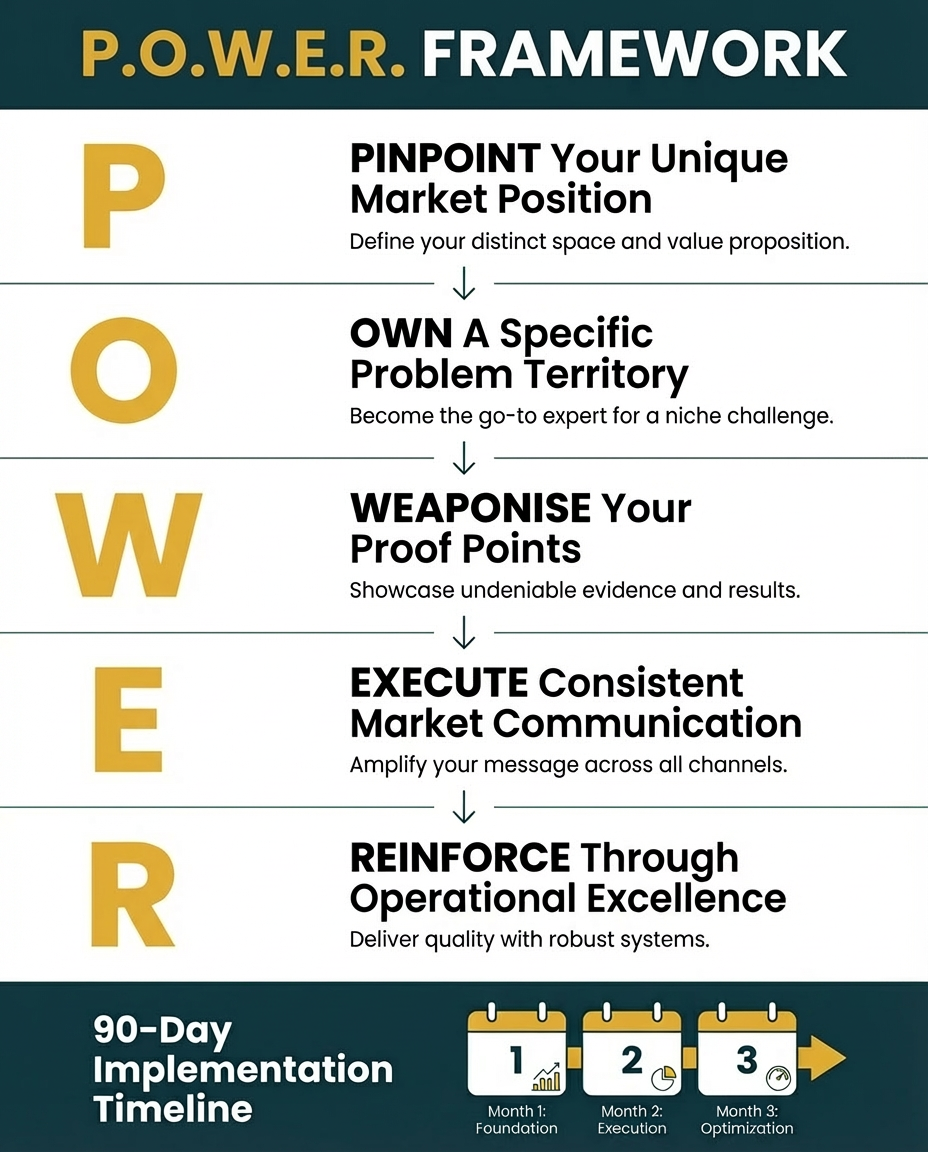
P - Pinpoint Your Unique Market Position
Start with brutal market reality assessment:
Customer Research Questions:
- What words do customers use when describing their problem?
- What happens if they don't solve this problem?
- What alternatives do they consider (including doing nothing)?
- Which outcomes matter most to their business success?
The Positioning Audit:
Map your current market perception against competitors. Where do customers see gaps? Which territories remain unclaimed?
Example:
Professional Services Positioning Map
- Legal firms: "Problem solvers" vs "Compliance experts" vs "Strategic advisors"
- Accountants: "Number crunchers" vs "Business growth partners" vs "Tax specialists"
- Consultants: "Industry experts" vs "Process optimisers" vs "Transformation leaders"
O - Own a Specific Problem Territory
Choose positioning that meets three non-negotiable criteria:
Urgent for Customers
They actively seek solutions and will pay to solve this problem now.
Unique to You
You deliver measurably superior outcomes in this specific area.
Undeniably Provable
You have concrete evidence that your positioning claim is true.
Positioning Examples That Work:
- "The only marketing agency that recovers £3,000+ monthly in lost opportunity cost"
- "Business systems that eliminate admin chaos permanently"
- "The accountants who prevent HMRC investigations before they happen"
W - Weaponise Your Proof Points
Strong positioning requires evidence, not just claims:
Quantified Results Documentation
Track specific metrics that demonstrate your unique value. Create monthly reports showing customer outcomes.
Case Study Development
Document detailed transformations with named customers (when possible). Include before-and-after scenarios with measurable improvements.
Third-Party Validation Systems
Build processes that generate ongoing testimonials, reviews, and referrals that confirm your positioning claims.
The Proof Stack Method:
- Level 1: Customer testimonials
- Level 2: Quantified case studies
- Level 3: Industry recognition
- Level 4: Media coverage/expert status
E - Execute Consistent Market Communication
Align every customer touchpoint around your chosen position:
Service Portfolio Alignment
Develop services that demonstrate your unique position. If you're "fastest response," create systems ensuring immediate customer contact.
Team Training Programme
Every staff member should explain why your business is uniquely valuable in 30 seconds or less.
Content Strategy Integration
All marketing materials, website content, and sales conversations must reinforce your position through specific examples and proof.
The Consistency Test:
Can a stranger understand your unique value within 10 seconds of visiting your website? If not, your positioning isn't clear enough.
R - Reinforce Through Operational Excellence
Build systems that deliver on positioning promises consistently:
Process Documentation
Create step-by-step procedures that ensure your positioning promise is delivered every time.
Quality Metrics Tracking
Measure and monitor the specific outcomes that support your positioning claims.
Continuous Improvement Systems
Regular review processes that strengthen your ability to deliver on positioning promises.
The Operational Alignment Formula:
Positioning Promise + Systematic Delivery + Consistent Measurement = Market Dominance
Example Positioning Success Stories
Case Study 1: Harrogate IT Support Company
Before: Generic "reliable IT support for local businesses"
After: "The only IT company that prevents system failures 30 days before they happen"
Result: 340% increase in premium service contracts, £127,000 additional revenue in first year
Case Study 2: Scarborough Marketing Agency
Before: "Creative marketing solutions for growing businesses"
After: "Marketing systems that recover £2,500+ monthly in lost opportunity cost"
Result: Average client value increased from £800 to £2,400 monthly, 6-month waiting list
Case Study 3: Leeds Business Consultant
Before: "Helping businesses grow and improve efficiency"
After: "The operational efficiency expert who eliminates £50K+ annual waste"
Result: Hourly rate increased from £95 to £275, referrals increased 400%
Your 90-Day Positioning Implementation Plan
Days 1-30: Research and Analysis
Week 1-2:
- Survey 10 recent customers about why they chose you
- Interview 5 lost prospects about why they chose competitors
- Document current results/outcomes you deliver
Week 3-4:
- Analyse competitor positioning claims and proof
- Identify market gaps and unclaimed territories
- Choose your specific positioning territory
Days 31-60: Foundation Building
Week 5-6:
- Develop proof points and case studies
- Create positioning statement and value proposition
- Train team on new positioning communication
Week 7-8:
- Update website and marketing materials
- Develop positioning-aligned service offerings
- Create measurement systems for positioning outcomes
Days 61-90: Market Testing and Refinement
Week 9-10:
- Launch positioning with existing customers
- Test market response through sales conversations
- Gather feedback and positioning effectiveness data
Week 11-12:
- Refine positioning based on market feedback
- Strengthen proof points with new evidence
- Develop long-term positioning reinforcement strategy
Avoiding the Five Fatal Positioning Mistakes
Mistake 1:
The Generic Value Trap
Claiming "high quality, great service, competitive prices" - every business says this.
Mistake 2:
The Competitor Copy
Positioning as "just like [successful competitor] but cheaper/faster" reinforces their market position.
Mistake 3:
The Constant Change Syndrome
Changing positioning every few months prevents market recognition from building.
Mistake 4:
The Proof-Free Promise
Making positioning claims without evidence destroys credibility permanently.
Mistake 5:
The Everything-to-Everyone Error
Trying to serve every market segment dilutes positioning power completely.
How to Measure Positioning Success
Leading Indicators (0-3 months):
- Customer inquiries mention your specific positioning
- Referrals increase month-over-month
- Sales conversations focus on value rather than price
Conversion Metrics (3-6 months):
- Higher close rates on qualified prospects
- Increased average transaction values
- Reduced sales cycle length
Market Position Indicators (6-12 months):
- Premium pricing acceptance
- Industry recognition and speaking opportunities
- Competitive wins against larger businesses
The Positioning ROI Formula:
(New Average Project Value - Previous Average) × Projects per Year = Annual Positioning Value
Why This Matters More in 2026 Than Ever Before
The challenging economic outlook makes positioning mistakes more costly and positioning advantages more valuable:
- Reduced Error Margins - With business investment slowing and consumer spending under pressure, ineffective positioning wastes precious resources that could determine business survival.
- Intensified Customer Deliberation
-
Tighter budgets mean customers research more thoroughly before purchasing. Clear positioning becomes the deciding factor between you and competitors.
- Market Consolidation Acceleration - Economic pressure forces weaker businesses out of markets. Those with strong positioning acquire their market share.
Your Positioning Success Starts Today
The businesses thriving in 2026 won't be those with the biggest marketing budgets or lowest prices. They'll be businesses with the clearest, most compelling positioning that customers immediately understand and value.
Strategic positioning isn't optional anymore - it's survival.
Your immediate next steps:
- Complete the positioning audit within the next 7 days
- Choose your unique market territory within 14 days
- Develop proof points within 30 days
- Launch positioning testing within 60 days
The businesses implementing positioning now enter 2026 with distinct advantages over competitors still competing on price and generic promises.
Every day you delay positioning work is another day losing potential premium revenue to better-positioned competitors.
Your market position for 2026 is being decided right now. Make sure you're the one deciding it.